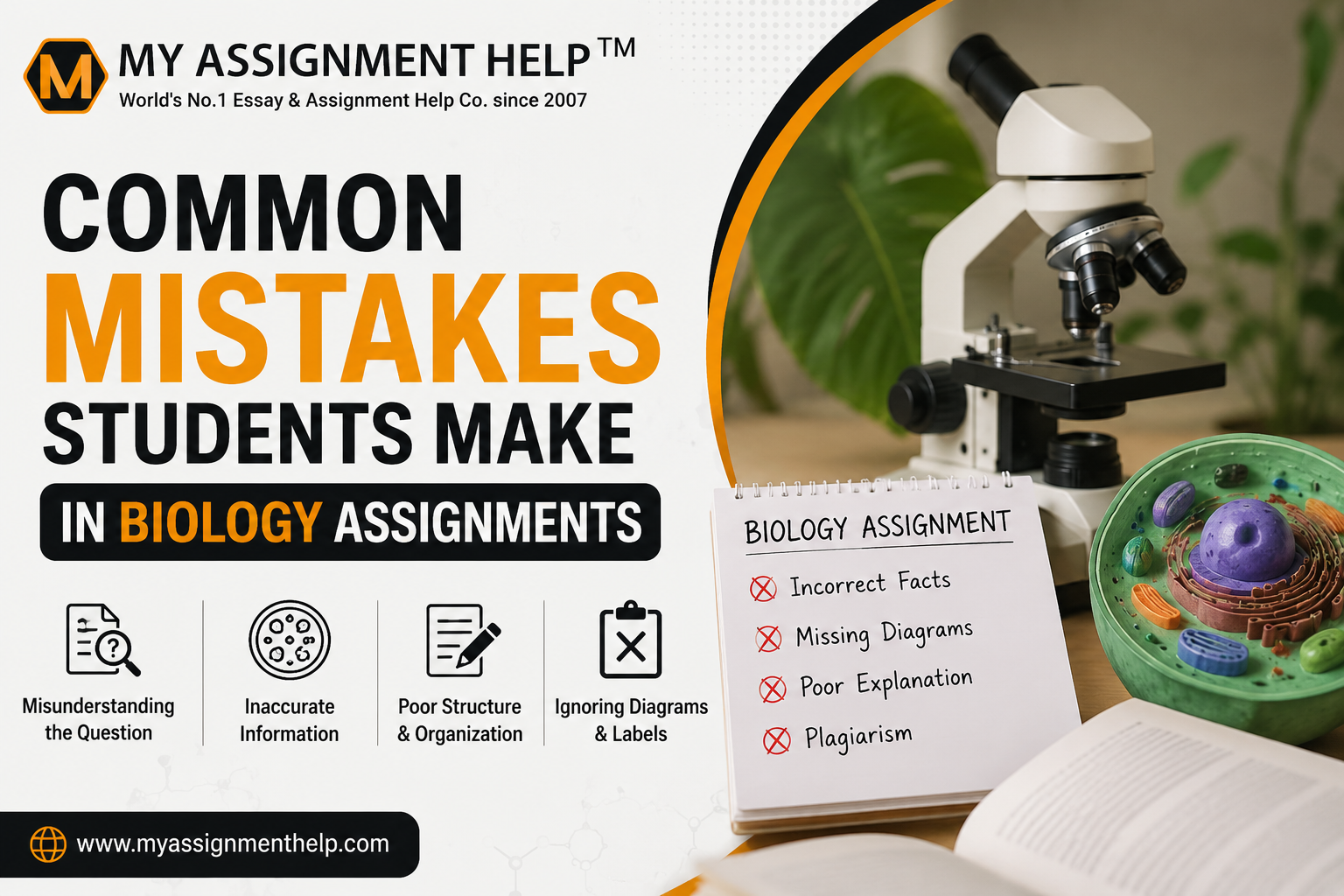
From the micro-level intricacies of cellular respiration to the macro-complexities of global ecosystems, biology is a vast and fascinating discipline. Yet, for many students across the United States, translating this fascination into a high-scoring academic assignment is a major hurdle.
The National Center for Education Statistics (NCES) consistently notes that STEM disciplines, including the biological sciences, see some of the highest rates of academic friction due to the rigorous demands of laboratory reporting and conceptual synthesis. Writing a biology assignment isn’t merely about memorizing facts; it requires data literacy, precise terminology, and a structural approach that mirrors peer-reviewed scientific literature.
When structural errors, misinterpretations, and poor research techniques slip through, they dilute the scientific authority of your work. This comprehensive guide breaks down the most common pitfalls students encounter in biology assignments, backed by academic insights, and provides actionable frameworks to avoid them.
1. The Nomenclature Trait: Misusing Scientific Names and Terminology
Biology has its own precise language. One of the most immediate indicators of a rushed or poorly researched assignment is the incorrect formatting of scientific nomenclature.
Binomial Nomenclature Blunders
In binomial nomenclature, organisms are identified by their genus and species names. According to the International Code of Zoological Nomenclature (ICZN) and the International Code of Nomenclature for algae, fungi, and plants (ICN), these names must follow strict typographical rules.
- The Mistake: Writing homo sapiens, Escherichia Coli, or panthera leo.
- The Correction: The genus name must always be capitalized, the species name must be lowercase, and the entire scientific name must be italicized (or underlined if handwritten). For example: Homo sapiens, Escherichia coli, and Panthera leo. After the first mention, the genus can be abbreviated (e.g., E. coli).
Vocabulary Confusion
Conflating highly specific biological terms is another frequent error that alters the entire meaning of an essay. Mistaking mitosis (somatic cell division) for meiosis (gamete production), or confusing transcription (DNA to RNA) with translation (RNA to protein), signals a lack of foundational understanding to a grader.
2. Methodology and Data Misrepresentation
Biology is fundamentally an empirical, data-driven science. Whether you are analyzing a laboratory experiment or writing a literature review, how you present data can make or break your assignment.
The Lack of Statistical Rigor
When writing lab reports, students often state conclusions without presenting the statistical evidence to support them. If your experiment measures the rate of enzyme activity at different temperatures, simply stating that “the enzyme worked faster at 37°C” is insufficient.
- What’s missing: You must include quantitative metrics—specific rates of reaction, standard deviations, p-values, or error bars on your charts.
Poor Figure and Table Hygiene
Figures and tables are often thrown into assignments as an afterthought. A common point deduction stems from missing or poorly formatted captions.
- Rule of Thumb: Tables are captioned above the data, while figures (graphs, diagrams, photos) are captioned below the visual. Every visual element must be self-explanatory and explicitly referenced within the body paragraphs (e.g., “As demonstrated in Figure 1.2…”). If you struggle to balance these strict structural conventions with heavy course loads, asking an expert to do my biology homework can help align your coursework with professional, publication-grade academic standards.
3. Structural Fails: Ignoring the IMRAD Format
For practical reports and experimental essays, standard essay formats fail to meet the structural expectations of scientific writing. Most biology departments in top US universities look for the IMRAD structure: Introduction, Methods, Results, and Discussion.
| Section | Common Student Mistake | Professional/Academic Expectation |
| Introduction | Providing a massive history of biology instead of focusing on the specific hypothesis. | Establish specific background context, state the research gap, and provide a clear, testable hypothesis. |
| Methods | Writing it like a cooking recipe or a bulleted checklist of steps. | Write in past tense, passive voice, third person. Describe the exact protocol so another scientist can replicate it. |
| Results | Interpreting and explaining why things happened within this section. | Purely objective presentation of data through text, tables, and graphs without editorializing. |
| Discussion | Repeating the raw results numbers all over again. | Interpret the data, explain anomalies, address limitations, and connect findings back to the original hypothesis. |
4. The E-E-A-T Deficit: Relying on Non-Peer-Reviewed Sources
In academic writing, Google is a starting point, not an acceptable bibliography. Under the lens of Google’s E-E-A-T (Experience, Expertise, Authoritativeness, and Trustworthiness) guidelines—which top academic evaluators mirror intuitively—the source material used defines the baseline authority of the paper.
The Pitfall of General Web Resource Obsession
Citing crowdsourced websites like Wikipedia, personal blogs, or commercial summary sites like Study.com drastically reduces the academic integrity of your work. These platforms lack peer review and are often overly simplified.
See also: newscrackle
The Solution: Navigating Primary and Secondary Scientific Literature
A high-scoring assignment relies heavily on primary literature (original research papers) and secondary literature (comprehensive review articles). Students should look for sources indexed in validated repositories, such as:
- PubMed / NCBI: The gold standard for biomedical and molecular biology literature.
- Google Scholar: Excellent for tracking citation metrics and discovering multi-disciplinary biological studies.
- PLOS Biology & Nature: High-impact, peer-reviewed open-access journals.
When managing strict timelines alongside multiple high-stakes modules, balancing these complex citation expectations can become overwhelming. In such instances, choosing a qualified service to do my assignment for me ensures your work is backed by authentic, peer-reviewed references tailored to your region’s exact curriculum demands.
5. Anthropomorphism and Teleological Language
Biology measures mechanisms, not motives. A subtle yet frequent error in student prose is the use of anthropomorphic language (giving human traits to non-human entities) or teleological language (implying that evolution or nature has a conscious design or goal).
- Incorrect (Teleological/Anthropomorphic): “Plants developed broad leaves so they could catch more sunlight because they wanted to maximize photosynthesis.”
- Correct (Scientific/Mechanistic): “Natural selection favored plants with broader leaves in low-light understory environments, as the increased surface area optimizes light absorption for photosynthesis.”
Cells do not “try” to maintain homeostasis, and DNA does not “want” to replicate. Keep your language strictly objective, causative, and focused on physical and chemical mechanisms.
Key Takeaways
- Master the Typographical Rules: Always italicize binomial nomenclature, capitalize the Genus, and keep the species lowercase (Homo sapiens).
- Format According to IMRAD: Keep your Results strictly objective and reserve your interpretations, anomalies, and hypotheses validations for the Discussion section.
- Ground Claims in High-EEAT Repositories: Never cite open wikis or general blogs. Rely on peer-reviewed repositories like PubMed, NCBI, and Google Scholar.
- Eliminate Conscious Intent in Prose: Purge teleological and anthropomorphic statements from your writing. Nature has mechanisms, not desires.
- Structure Visual Data Correctly: Caption tables above and figures below, ensuring all visual metrics include units of measurement and statistical variance where applicable.
Frequently Asked Questions (FAQs)
Q1: What is the difference between a figure and a table in a biology assignment?
Ans: A table presents raw or processed numerical data arranged in rows and columns. A figure is any visual, non-textual element that is not a table, including line graphs, bar charts, photographs of gel electrophoresis, or anatomical diagrams. Tables require titles positioned directly above them, while figures require descriptive captions positioned directly below them.
Q2: Why is passive voice preferred in the Methods section of a lab report?
Ans: The Methods section focuses on the experiment itself, not the person performing it. Using the third-person passive voice (e.g., “The solution was centrifuged at 3000 rpm for 10 minutes”) ensures the focus stays entirely on the replicable scientific process rather than the individual researcher (“I centrifuged the solution…”).
Q3: How do I properly cite a web source in CSE (Council of Science Editors) style?
Ans: Under CSE style, a citation for an online resource must include the author(s) or issuing organization, the publication year, the title of the page, the URL, and the exact date you accessed the material. For example:
National Center for Biotechnology Information [NCBI]. 2026. Molecular Biology Databases. https://www.ncbi.nlm.nih.gov/ [Accessed 2026 May 20].
Q4: Can I use abbreviations for biological terms without defining them?
Ans: No. Every abbreviation, acronym, or initialism (such as ATP, PCR, or CRISPR) must be spelled out completely upon its very first appearance in the text, followed by the abbreviation in parentheses. Example: “We utilized Polymerase Chain Reaction (PCR) to amplify the target DNA sequence.” After this initial definition, you may use the abbreviation freely throughout the assignment.
Author Biography
Dr. Eleanor Vance Senior Academic Consultant & Lead Content Strategist at MyAssignmentHelp
Dr. Eleanor Vance holds a Ph.D. in Molecular Biology from the University of Texas at Austin, with over eight years of experience in both laboratory research and undergraduate instruction. As a senior academic writer and content specialist, she works directly with international student bodies to demystify complex STEM curricula. Her research focuses on optimizing scientific communication, helping students translate dense experimental data into authoritative, structurally sound, and high-scoring academic papers.
